
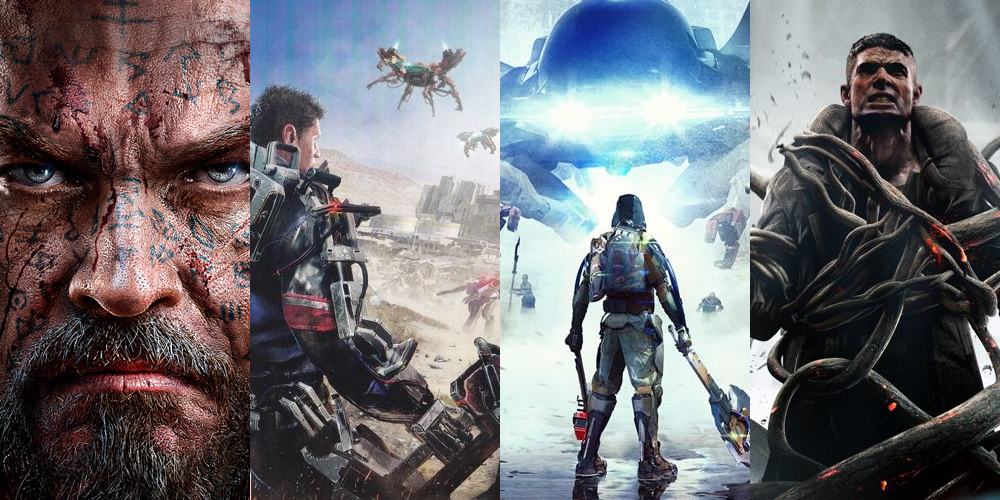
I am John Dark Souls. I don’t know what happened, but all of a sudden I’ve been completely enchanted by Souls-likes. It’s not like I haven’t played one before, falling for Elden Ring on release years ago and subsequently enjoyed many such games since, but the start of 2026 has marked an abrupt and intense dedication for the Souls-like genre. I can’t get enough!
Upon completion of Dark Souls 3, I found myself at a crossroads. Still yearning for the Souls experience, I could replay a game a love like Dark Souls 1 or Lies of P, I could try one of these newfangled big budget Souls-likes such as Wukong or Wuchang. Or I could play the worst god-damn games of the lot. Naturally, I took the latter option, attempting somewhat to experience the genre in a sort of chronology. Lords of the Fallen was from what I can tell the first non-FromSoftware take on the genre, and I summed up my thoughts in a review published this week. In short: NOOOOOOOOOOOOOOOOOOOOOOPE.
Developer Deck13 (without the collaboration of CI Games) produced another Souls-like a few years later in The Surge, abandoning their prior derivative fantasy land for a fresh, futuristic hellscape whilst also notably turning away from the dodge-centric gameplay FromSoft’s output had/has been known for. In my Lords of the Fallen review, I end with an allusion to the game’s non-combat elements, and how even if they were interesting in themselves they wouldn’t be worth discussing considering the Mount Olympus sized hurdle you’d have to clear to appreciate it. The Surge, perhaps even more disappointingly, is one such example of a game composed of plenty of interesting components, but the result falls on deaf ears and blind eyes – both of which being rage-induced, stemming from the frustrating absence of reliable damage mitigation methods.
Take your old mate Dark Souls for example: In that game (and every successful one like it), you have at least one way of mitigating damage at any given time, be it through making use of invincibility frames via dodging, killing the enemy at range before they can get a hit in, or plonking a big fuck off shield in front of you. They all come with benefits, downsides, risks, and feasibilities, like how with dodging you risk taking the full brunt of an attack if mistimed, but leaping on cue opens the enemy up to a more punishing counter than the comparatively safer option of guarding. Notably, when one seems less viable, you can opt for another.
The Surge’s fatal flaw is that none of them work. It’s tough to know what the game is going for. Preemptive range attacks are out the question, since your drone is your only mode of ranged attack, and it requires some prior melee, energy-building tussling to function. Dodging too is almost useless as there doesn’t appear to be any iframes associated with it, and thus the dodge button is used exclusively for positioning. Blocking should, therefore, be the focus, as is the case in games like Sekiro or Lies of P. The Surge 2 offers some perspective into what would eventually come of the first games hokey directional block system, where you’re rewarded for correct timing and directional input with a devastatingly punchy blow. Nothing of the sort really exists with the first game though, limited to simple blocking high or blocking low whereby the risk of getting the direction wrong is a full bonk on the noggin, and the reward is, uhhh… not taking damage, I suppose. Piling on top of an already unfulfilling system is how enemy attack animation don’t seem to match the direction you need to block. The outward swipe of an early game enemy seems to imply a high attack, but you need to hit down on the stick to actually prevent damage. Other times, even blocking correctly, I would lose health either way. Partly to blame is the knuckleheaded decision to make it so the player takes full damage if they don’t have enough stamina to block it fully. The other part is just a cosmic guess as to why I’m taking damage. I quit around this point of confusion.
The Surge 2 however is a marked improvement in this regard, and while the unsettling darkness of the first game has been lost in favour of a somewhat sterile and cluttered outdoors, the boon of a functioning, engaging parry system makes the whole experience far more pleasant. It’s not perfect, mind; there were still instances where I’d confidently believe a parry should’ve worked when it didn’t, and some enemy attack patterns can spiral into an onslaught of multi hits, impossible to escape. But when it works, it strikes the same blissful notes of a perfect Sekiro parry. From a visual standpoint, The Surge 2 depicts combat information a lot better, with one “implant” even showing you the direction to parry, rather than eyeing the enemies attack yourself. With or without it, it works significantly smoother than the shoddy system in the first game.
While I’m not averse to being constrained to a certain play style, it is one of a few design decisions which has me hesitant to place The Surge 2 higher than a solid good out of 10. Since every encounter will rely mostly on blocking, combat lacks variety, and build diversity generally is lacking. To the game’s credit, levelling is streamlined into simple health, stamina, and energy attributes, and subsequently there are no strength or dexterity requirements to use different weapons. I found myself swapping between bulky slabs of metal and sleek elemental spears often which was nice, but nothing breaks the loop of parry then counter attack, which does begin to tire after a while. It’s also worth noting I failed to see a difference between weapons within the same class, for example all single rigged weapons had the same move set and thus my excessive arsenal felt a bit padded.
I enjoyed my time with the game, though not enough to dive into the DLC. Gideon’s Rock was a standout location, in equal part due to its lush scenery and well balanced enemy placements as it was for it’s overall concept, a bombastic monster hunt intertwined with a subplot of human deceit. While most areas are distinct in tone, I didn’t think any hit the peak of tracking a big robot dinosaur. That’s unfortunately where The Surge 2 slips. Rather than one particularly egregious flaw, the game does what it sets out to do well, has a distinct identity, but ends up pinning itself down into a specific niche and quickly becomes one note, even if that one note is mostly mellifluous.
A replay this time with Remnant: From The Ashes, a third person shooter with Souls-like elements. Games like this are what turn genre discourse into a minefield; exacerbated by the loose definition of “Souls-like” itself and buried deeper into ruin by Remnant’s divergence from what consensus would consider core attributes of the genre. In my estimation, if “Souls-lite” was a thing, it would certainly fall into that. The signs of inspiration found within the game are too plentiful for it to simply be a run-of-the-mill shooter, whilst the deviations very much make it its own thing. Namely, the focus on boss fights, the harder-than-normal difficulty, the Estus thingamajig, and the slow and subtle storytelling all combine to give off a whiff of Soulsyness, and the obvious change to third person and, even more starkly, the focus on guns places Remnant in a unique spot, satisfying a few potential niches.
As a fan of both wave-based third person shooters and Souls-likes, Remnant ticks a lot of boxes for me. The most evident success is the combat itself. Every gun I tried had a palpable punch, and each one occupies a wholly distinct role and purpose, making loadout construction quite engaging. I can envisage a handful of potential builds, abetted by weapon mods (basically skills charged through combat) and armor passives, such as one with a melee focus, ones which buff you on successful dodges, or the one I ended up slipping into where you go all in on mod generation, resulting in encounters which skew the game more towards fantasy as I had a rapid supply of radiation balls to sling at enemies like a wizard. It’s a darn good looking game, and it’s always changing as you warp between different worlds. Even the manky and worn down looking Earth has its charm alongside the more exotic planets like the hellish Rhom or verdant Yaesha. While I would’ve liked more to cling to in terms of story – since it treads in FromSoft’s footsteps by being rather vague and indirect – I did like what was here, and each world’s subplot was, if only on the surface, enticing and intriguing.
My main issue with Remnant stems from its seeming intent as something you play more than once. There are a few design decisions which further this goal, like how instead of a set boss path, most locations have a potential pool to select one, so if you want to see them all, you need to reroll a fresh campaign. The level layouts too are procedurally generated to an extent, meaning each subsequent play though should, in theory, never play the same. Unfortunately I think these decisions end up degrading the first time experience. Each level for example is about twice as big as it needs to be, with open stretches of nothingness, no enemies nor notable loot to make trudging around worthwhile. The ingenuity that can arise from bespoke level design is lost in favour of making replays feel a bit different, and I’d posit it’s not the correct approach. And I don’t know how this came about, but the game abruptly ends at what I would’ve assumed was the midpoint, finalising in a truly grueling gimmick fight. It’s jarring, in part because the boss fights by and large are excellent, but also in terms of pacing, the game builds up towards a certain character whose reveal and development is both anticlimactic and nonexistent respectively.
I don’t think the negatives outweigh the positives in this case, and despite my prior knowledge from my first playthrough that this was how the game was, it didn’t stop me from going back to it for the sheer enjoyment of its tightly crafted combat.

 Breaking the Backlog
Leave a comment