
Despite my best interests and better judgement, there remains within me a compulsion to finish every game I play. It’s an utterly foolish endeavour, stemming from a preconceived notion I had early into my video game criticism journey that you can’t truthfully or accurately assess a game unless you’ve experienced it fully. It’s a mindset that breaks down on so many fronts it’s arguably not even worth discussing, though as I get older and reckon with the passage of time, I find the most compelling rebuttal to this way of thinking is that incompletion is as valuable an indicator as full completion is. Lords of the Fallen is one such as example which I gave my all. I scoured Reddit posts for tips, I watched playthroughs of certain troubling areas, and I overall game it way more time than I should’ve. Lords of the Fallen is an utter failure of a game, and in spite of the completion mindset I still begrudgingly hold, the fact I’ve left it unfinished is as big a statement to its quality as anything I could write could be.
2014 Lords of the Fallen, I should clarify. Lords of the Fallen is bafflingly a franchise now, with a 2023 sequel/reboot in the wild and a sequel to that on the way. My use of adjectives is a result of confusion as to what CI Games really saw about this IP that needed a fresh coat of paint. Lords of the Fallen, the 2014 iteration, is a frankly dull and derivative fantasy Souls-like. It’s notable almost exclusively for being arguably the first 3D Souls-like, making use of the first-mover advantage to establish a name for itself in spite of the otherwise woefully generic game world. It utilises mechanics and philosophies common place in the Souls games: experience points dropped on death, slow and methodical combat, a keen focus on level exploration, and of course a cripplingly hard difficulty. And since it’s “borrowing” so heavily from the Souls series, it opts for a fantasy land plunged into peril by the sinister Rhogar, where naturally the only person who could save the world is some guy in prison. Seems familiar.
The vapidness of Lords of the Fallen’s world is unfortunately the least of the game’s problems. Top to bottom, LotF proves to be a cheap, broken, and misguided attempt at copying a game the developers liked. It doesn’t have an auspicious start. With what might be a video game first, developer Deck13 seemingly employs an actual camera operator to guide the player’s view. Much to our chagrin, they’re either in permanent hysterics that someone actually bought this bloody game, or their motor skills are incredibly impaired as the camera will wobble and shake constantly to a sickening degree. Like genuinely stomach churning levels of cinematic flair going on here, with it only getting worse as the game attempts to respond to player input, tossing your view around the screen in a dramatic display seemingly trying to emphasise how “badass” what you did was. The only thing I’m seeing after a few whirls of the camera-go-round is the bottom of a sick bucket.
The badassery never really exists though. It’s alluded to with our player protagonist’s gruff Vinnie Jones impersonation and his insouciant interactions with other characters, but it’s never realised within the game itself. Certainly not the combat, which misses the mark so hard I question whether Deck13 actually do like Dark Souls. One of the lovely things about the Souls series (and RPG’s at large) are the options they offer in build diversity. While I make every Souls-like know my predilection for beefy strength weapons will always be my first call to action, I do occasionally experiment with the other paths at my disposal. LotF isn’t as clear in this regard to any build diversity. The player avatar Harkyn can technically do it all: a bit of magic here, a slab of metal for a shield there, and hey, you can wield a dagger if you want to. I’m not opposed to this approach, of allowing dynamic, spontaneous build changes, but LotF doesn’t succeed in making any of these potential paths profitable, if by “profit” we tweak slightly to mean “progress at all with the game”.
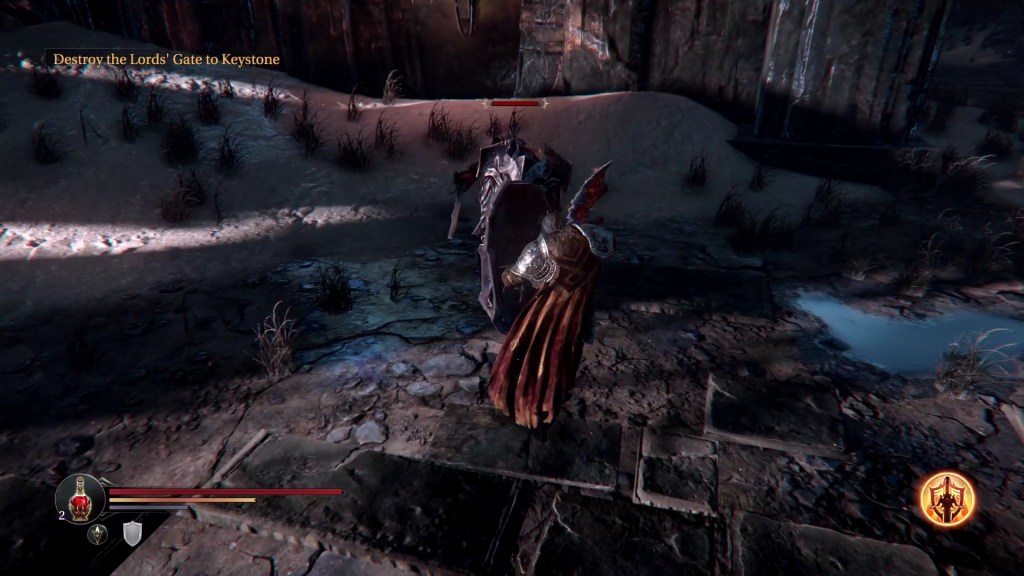
Harkyn swings his sword like he’s never once in his life had control over his body. Movement, and by association combat, is a sluggish and imprecise affair where you drunkingly lurch your sword towards enemies and hope it connects. For the first hour, enemies employ the tried, tested, and failed strategy of just lunging at you with no thought of defence. Such enemies can be felled rather easy, but shields prove a serious problem for the game. Other Souls games get around potential issues of turtling by giving those enemies a weakness somehow. Often they’ll respond to you attacking their shield with a lumbering swing, opening them up for a counter, or maybe the sheer heft of their shield makes them slow on the turn, allowing for a deft backstab. LotF offers no such opportunities outside a shield bash, awkwardly initiated by sprinting and then blocking. The icing on the cake is that the enemies’ stagger animation is shorter than the time it takes Harkyn to recover from his clumsy technique. My aforementioned adoration for strength weapons ties into my favoured damage mitigation technique of dodging, since I typically can’t spare the equip load for a shield. Dodging in LotF is miserable and only furthers the image of Harkyn’s drunkenly state. There does exist invincibility frame here, somewhere, though it seems to be when the player is actively rolling on the floor, meaning the first frames of your dodge don’t actually do anything in the pursuit of avoiding damage. To bring this back to enemies with shields, timing a perfect dodge still doesn’t help us in striking a blow as again most enemies don’t fit into the game’s otherwise lethargic pace, resetting to neutral after an attack far quicker than we can dodge into position for out own counter.
LotF’s combat is nothing short of a war of attrition, a glacial game of waiting for someone to make a slight mistake, though the odds do seem tilted towards the NPC’s. Some enemy attacks penetrate your guard for reasons I couldn’t ascertain, and dodging is so unreliable – even if you strip bare and benefit from the game’s “fast roll” – that employing that strategy opens you up to even more hits. Deck13’s next’s effort, The Surge, followed in this game’s footsteps of having similar damage mitigation issues, though they at least had the awareness to make enemy attacks have a consequence in slow recovery times. LotF’s is a worst of all world’s situation where no potential mode of attack works. Heavy warhammers can break an enemies guard the same as a shield bash, but leads to the same result where you’re left with too little time to make use of the opening. Quick weapons like shortswords fare even worse, incapable of staggering those without fortification and lacking the damage to kill them outright, meaning you will more than likely take some damage in the fight anyway.
As with The Surge, I could talk about everything outside the combat, but for whose benefit? If Dark Souls suffered similar snags, would you bother singing the graces of Anor Londo’s beauty and majesty, praising the resonant melancholic notes found within Firelink Shrines theme, or revelling in the hate-fuelled adrenaline found in the depths of Blighttown? Unlike Deck13’s next Souls-like effort, Lords of the Fallen is a truly flaccid experience devoid of merit. If its mechanical incompetence were shrouding the intricacies found within its game world, I would perhaps feel a sense of regret by overlooking them. But I feel no regret, for Lords of the Fallen is entirely forgettable. It’s a game that can generously be described as dull; an inchoate attempt within a burgeoning genre that fails to impress. It’s been supplanted in visibility by a game that snatches its name in its entirety and is, supposedly, a decent time, which the original could never hope to achieve. The Lords of the Fallen name will be remembered, though what people associate with that name will almost definitely not be this.


 Breaking the Backlog
Leave a comment