
I don’t think there’s a single piece to The Witcher that impresses a sense of mastery. Combat attempts to replicate the swift elegance of Geralt’s slashes and pirouettes, but fettered to the Aurora Engine, it plays out with more or less the same grace as the Star Wars Kid. The lofty aims of the narrative being told, retreading the themes and moral dilemmas of the books, often fall short in execution, be it with passionless voice performances, elongated questlines, or simply hokey moment-to-moment dialogue. The alchemy system, the famed Witcher tonics and narcotics, are abundant and varied, yet rarely does the game encourage their production, with the journal in equal part to blame, which in theory slowly expands your knowledge of monsters and their “unique” weaknesses, though they all fall into using the silver sword utilising one of two stances. The Witcher is a flawed game, seemingly gasping for a higher budget and more technological prowess, and yet despite nothing clicking into place how it should, it’s absolutely worth a play.
We take control of Geralt a few years after the events of the books, struck with blinding, near total amnesia. His fairytale feats are lost to him, people he held close foreign, and even concepts such as his Witcher brews and the monsters he’s slain are lost in the ether. It’s a naff conceit to be frank, though it’s apparent that its use here is a way to introduce people to the world of the Witcher who haven’t invested time into the novels. He’s a blank slate, where beasties such as bruxas, drowners, and strigas blend into one until we research their existence, which in fairness is a neat idea. Slowly over the course of the game, we build up an expansive repertoire of tomes and manuals detailing how to most effectively face each foe, along with a growing collection of potions to concoct, and an ever growing journal detailing characters, locations, and concepts which serve to aid Geralt in remembering who he was.
Like I said, it’s a bit lazy, but effective. Combat is perfunctory, and hits that middling standard in part due to how knowledge influences encounters, at least to start with. Using the Aurora Engine – which to my knowledge is only used elsewhere by the Neverwinter Nights games – it’s not exactly a well oiled machine. Geralt employs different “styles”: strong, fast, and group, and deciding which one to use requires either intuition or erudition of the enemies corresponding journal page. It’s something better in concept, and in practise you can most often employ the strategy of using the strong style against big, lumbering meatbags, the fast style against spindly agile sorts, and the group style when outnumbered by anything. This goes some way to describing the limitations of the journal integration, as it quickly becomes redundant as enemies begin to blend into these easily identifiable groups. Many journal pages offer other information, ranging from lore descriptions to the more functional tactical advice, though again, the game’s broader flat difficulty doesn’t necessitate engaging with it. Many monsters will be weak to certain blade coatings for example, though still succumb to the silver sword in a flash even without one applied, thus not really serving any purpose in this form.
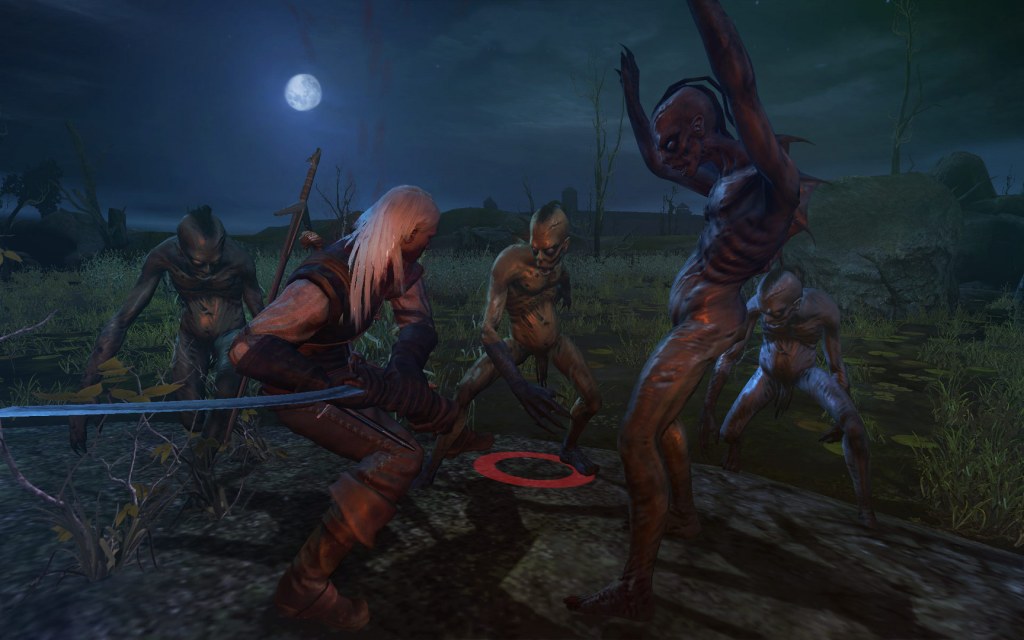
At a more birds eye perspective, the combat – while clearly chained to the stilted rhythm of the Aurora Engine – can produce some well executed scenes of silky, theatrical conflict. There’s really not much more to it than clicking on the enemy you want to attack and ensuring you’re in the correct style, but through some tight animation work, high combo moves (achieved by simply clicking on the enemy when the cursor flashes) are flashy, and evoke their styles pretty well, with the last stages of a fast style combo playing it in satisfyingly blistering speed, while the last leap of a strong slash has some real oomph behind it. The Witcher Signs, a sort of weak level magic quickly forgotten in the books is revived here in the form of five varied spells. A quick Google seems to suggest each one is overpowered in their own way, but I had the most fun using the Axii sign to temporarily turn foe to friend while searing their allies-turned-adversaries with the Igni sign. Again it’s not exactly a technical tour de force as trying to use signs while already in an attack animation for example will just result in periods of static nothingness, but when it works, it can supplement the flashiness of the rest of the combat quite well.
Acutely related to the combat is the alchemy system, which is another Witcher concept sort of left by the wayside in the books, but is picked up here to mixed effect. On the one hand, I love the theoretical idea of Witcher concoctions; elixirs, potions, and brews which directly heighten the already superior Witcher abilities and stress the importance of forethought. As I’ve already highlighted though, in practice combat rarely needs preparation, and most encounters can be cleared most often without any supplements, bar maybe Swallow, a health regeneration potion. In theory though, the alchemy system is quite robust, allowing Geralt to create remedies through the knowledge gained by books and scrolls or through experimentation. We accumulate an abundance of ingredients throughout the game, both from flora and bits of the beasts we slay, and each potential brew requires certain parts, a few sprigs of this plant here and bit of drowner brain there and we have a way to see in the dark. Others enhance our sword damage, others make our signs more effective, allow us to see through walls, boost our defences, or even turn our blood to poison, so any blood suckers are in for a surprise when they decide to sink their teeth into us. Ultimately, its surplus to requirements, as, to sound like a broken record, the game’s normal difficulty simply doesn’t encourage using them all that often.
One common notion I saw when looking at opinions of the combat online was one of ignoring it as much as possible. Stick the difficulty on easy and enjoy the story. Because really, The Witcher is closer to old school RPG’s than it is a hack ‘n slash brawler. So how is the story? To keep the same record in rotation, it’s something in concept quite neat, but doesn’t fully stick in the landing in the field. While the overarching plot of The Witcher is new, I came away viewing the overall game as something akin to a soft reboot, a retreading of many of the themes of the books, specifically the short stories. Destiny, neutrality, good vs evil, man vs monster. Plenty of quests ask a question, and have you (and thus Geralt) answer it. Do you burn the witch for bringing about a curse of demonic dogs, or do conclude demons only come about as a result of human immorality? Do you kill the werewolf out of principle, as the Witcher code to defend humanity states, or do you view their own vigilante justice as the lesser evil? These are dilemmas which make the short story collections so endearing, and by and large the game implements them here to great effect. Though where it stumbles is in the more moment-to-moment details, namely the dialogue. Perhaps this is a translation thing – assuming the script was first written in Polish – because conversations often give the impression that different writers were assigned a character, given a prompt, and wrote their retorts and rejoinders in secret. Geralt can at times evoke his characteristic dry wit, but more often than not comes off as stoically dull. Dandelion is the biggest victim here, lacking so much of his performative, flowery, yet affable articulation in service of an uncanny facsimile. Directly pertaining to quests, they can often feel underdeveloped, not because those larger concepts aren’t interesting, but instead because the path to exploring them is filled with underdeveloped, ineloquent speech.
Pondering on The Witcher’s place in the now bustling, quickly expanding universe – one with two short story collections, five (soon to be six) novels, a full fat side adventure, two tv shows, and plenty of video games – I’m left thinking that were someone averse to reading the books, The Witcher is a pretty fine starting point. In fact, I would argue CD Project RED seem less interested in telling their own story here than they are exploring the themes Sapkowski already had his fingers in with the books. The result is something which offers new material for fans of the IP, yet is also more than welcoming to those that aren’t. It’s flawed, in every way possible really, though those pitfalls come off more as areas for improvement than fatal, unforgivable shortcomings. Taken as a whole, The Witcher proves more a victim of its own ambition, trying to tie together bundles of mechanics while remaining true to the source material, and while the end product might have its blemishes, I’ll take imperfect adaptation over a tacky tie in any day of the week.

 Breaking the Backlog
Leave a comment