
I’m reluctant to even call Luck be a Landlord a rogue-lite. True to the roots of a slot machine, it’s inextricably tied to random chance. Entering a “run”, there are no classes, no builds, no perks or bonus items, no (player controlled) modifiers. It’s a game about spinning a slot machine and letting fate take the wheel. Based on that alone, the game is a tough sell, and where it not for the words of Balatro dev, LocalThunk, I wouldn’t have bothered with it. And while it’s in no way as good as Balatro – I mean, what is? – I can totally see the inspiration, and that precise giddiness which comes from seeing the numbers go big like in a game like Balatro is, to a lesser extent, present here.
As is probably very obvious, a lot of my thoughts on this game are in relation to Balatro, though it’s worth stressing how different they are in many ways. For one, Luck be a Landlord is mechanically much simpler. It’s not an exaggeration to say it’s a literal slot machine, though the fiscally exploitative underbelly of the gambling world is thankfully absent. We spin the machine, win virtual cash for the value of each symbol shown, complete the loop by, if we so wish, adding a new symbol to our collection. Where you’d see 7’s, hearts, and fruits on a traditional machine, we also see that here, though there worth is twisted and warped to facilitate wacky combos. Fruit for example range from bananas worth one coin to strawberries worth three. The magic is often in how they interact with other symbols. Bananas are imbued with the power to destroy thief symbols, of which leech coin from you each spin, but return a multiple of the combined stolen currency when tripped by the pesky potassium-filled produce. Strawberries score high, but score even higher for each other strawberry on the board. Cow symbols have a chance to produce milk, which cat symbols can drink for an immediate cash injection. Keys score low by themselves, but naturally open the locks of chests, brimming with coin.
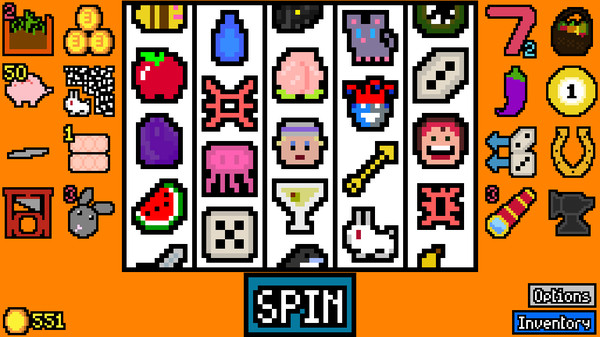
By the late game, these interactions can get truly wacky, emphasised by the slowly rising pitch of the audio ding which plays every time a symbol scores. Some of my favourite symbols are those which destroy others symbols and increase in passive value as a result. Divers for example can remove common aquatic beasts from the board like jellyfish and turtles, both to make space for new symbols but also to increase in value itself. Symbols like the oyster – similar to the cow – have the chance to pop out a pearl, which the diver thusly devours, creating a farm of sorts for consistent profit. The item system builds on this, acquired sporadically through a run, which help you build a more focused strategy. Some give a passive chance to unlock chests without the need for keys, others simply increase the value of certain symbols. They can manipulate how often a symbol produces coin, how likely they are to produce another symbol, or how long they stick around before imploding. The result of all these interactions is, if lucky of course, big, chungus, numbers – which is specifically what LocalThunk points out when crediting this game as an influence in making Balatro.
However the likelihood of hitting these euphoric moments is limited by lady luck, and she do be a landlord, and much like a landlord, she also be fickle and unreliable. Unlocking a new deck in Balatro and exploring the new ways you can interact with the game’s jokers was a truly once-in-a-lifetime experience, a constant barrage of ingenuity and player choice. With Luck be a Landlord, we really don’t have any choice, which in the theme of renting is very apt, but as a video game can be quite frustrating. As I said before, we can’t influence anything prior to a run, so I often found myself (especially at higher difficulties) getting a few spins in and restarting when it became apparent nothing was coming together. It also means you can’t strategise or play with an archetype you want to. Even if you manage to land yourself that one symbol you want – which for me was often the geologist – you also need those combo symbols, and in many cases they get destroyed in the money making process. As a result, where Balatro can reliably give you these hits of dopamine, Luck be a Landlord is much more conservative with how often it rewards you.
You’ll know whether you’ll jive with Luck be a Landlord within the first 15 minutes. While there are plenty of symbols and interactions to discover, its adherence to randomness means it doesn’t offer much in the way of critical thinking, nor does it get harder in a satisfying fashion. Each level (of which there are 20) introduces a slight debuff, like a higher “rent” requirement to not fail the run, or dud X symbols being stuffed into your machine. But without reliable ways to counteract these challenges, Luck be a Landlord progressively exposes how shallow the strategy side of it is. All the while it doesn’t exactly become less fun. In a way, because it demands less of your attention, Luck be a Landlord is a fantastic game to play with a podcast on in the background, though compliments like that don’t exactly sing the game’s praises. I do truly believe Luck be a Landlord is a fun time even without the need for external stimulation, though understanding its limits is key to getting the most out of it.

 Breaking the Backlog
Leave a comment