

What can I say about Super Mario 64 that hasn’t already been said? It’s a game that has been so thoroughly deconstructed – be it through analysis and manipulation of its source code, or iconic theoretical physics YouTube videos – that saying anything other than “it’s good” feels like wasted breath. In 2024, I’d posit it’s not as simple as that however, especially after modern iterations on both the genre and series have proven wildly successful, and in some situations, plainly better.
Though it’s worth noting that what a lot of these newer games improve on are results of literal decades of experimentation and learning. Most precisely, to highlight one such (and in my opinion the definitive) improvement made is in how a camera should work in 3D space. Nintendo’s 1996 attempt at giving the player a useful lens into this dastardly new dimension isn’t great, mashing together two quickly swappable angles: one from the cloud-riding Lakatu who aims to track Mario from the air, the other from a sort of behind the hat perspective, allowing you to see in front of Mario at almost all times. Both aren’t great, and in my experience, I spent a lot of time spamming the swap button attempting to unstick myself from a dodgy angle or even just figure out what the hell I’m looking at. It was a frequent occurrence watching Mario take a walk off a ledge as I stoically hold forward on the analog stick, as a result of the antsy camera shifting and fidgeting around constantly.
I suppose I’m putting the Mario before the Yoshi here, because I haven’t – as if this needs describing – explained what this newfangled Super Mario 64 is all about. As the first 3D Mario game, it bares a striking resemblance to its 2D depiction, at least in the movement department. I’m constantly vacillating as to whether I like how Mario feels on the 2D plane, as Nintendo often give the impression his feet are made of ice. Here, in the polygonal visual beauty of the N64, Mario is indeed a slippery bastard, though unlike my indecisiveness with regards to the NES and SNES versions, I do quite like this Mario’s ballerina-like leaps and dancer-like slides. For sure, there are instances I’m on all fours crawling towards a coin balanced on a pixel’s edge, but for the most part, Mario’s momentum feels wonderful. Precise platforming can be tough, but large portions of Super Mario 64 are more freeform and open, offering vast fields of grass, snow, and sand to hop around in. Mario is weighty. I feel the impact of his somersault so intensely I find myself flipping around just for the visceral fun of it. His long jump – a prerequisite for the hilariously fun “backwards long jump” exploit – has so much air time and manoeuvrability that I dare say it’s the best Mario has ever felt, pre and post 1996.
Mario’s environment is perhaps just as important to what makes a Mario game click as how he feels to control. Experiencing Super Mario 64’s levels is like being hit by cannon blasting sheer joy, despite several of which exhibiting eye twitchingly irritating aspects. Mario 64 is a vibe, as the kids say. It’s pure childlike innocence bottled up and stuck on a cartridge. And it’s twofold; visually, everything from the N64’s catalogue is showing wrinkles, and Mario 64 is no different, yet it makes up for that bold colours bursting from their seems, expressive 3D interpretations of classic characters, and level design which mimics the architecture of a kids toy, small in scope, but brimming with little quirks to prod and poke at. Super Mario 64’s audio is timeless, iconic, and grin inducing. It’s no wonder than YouTubers from seemingly every genre of video can be found using Bob-omb Battlefields uptempo bops as undercurrents to their work. Just as incredible is composer Koji Kondo’s ability to gracefully pirouette between emotions, from the headbopping tunes of the slide theme, to the mellow, slightly sinister ambience of Lethal Lava Land, to the meditative relaxation of Dire Dire Docks.
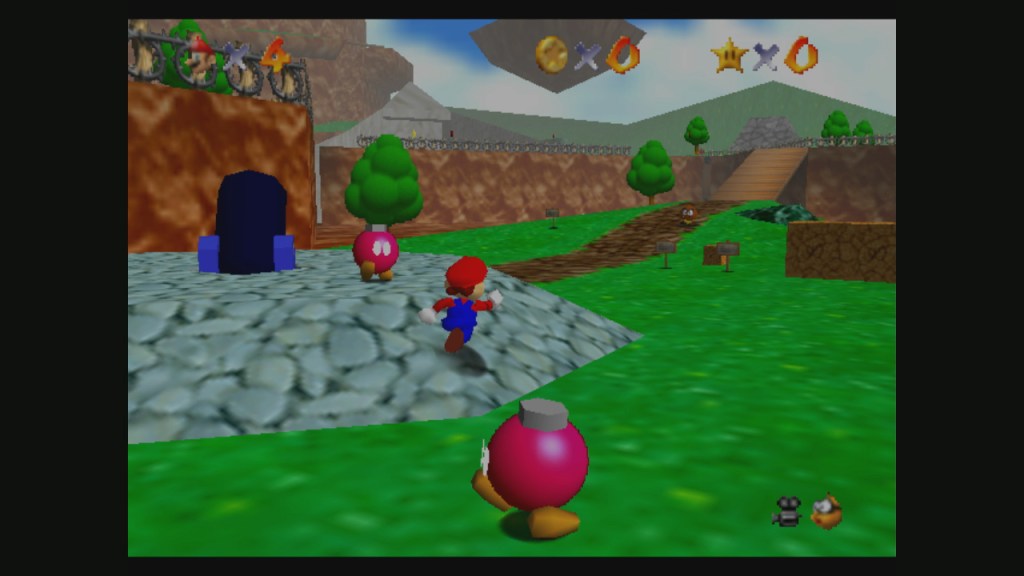
But yes, there are annoyances when it comes to navigating these levels when not exclusively basking in the unadulterated bliss. Relating back to Mario’s tricky movement, some levels are complete death traps. Many lack physical walls, and consequently I lost count of how many times I fell to to my demise outside the small boundary of Tiny Huge Land. Shifting Sand Land is caked in instadeath quicksand, and many of the levels objectives require you navigate dangerously close to it. Cold, Cold Mountain is an early irritant, combining everything, from the lack of outer guardrails, to the placement of red coins, teetering right on the world’s edge, along with the bonus modifier of its naturally icy terrain making Mario’s inherent slipperiness even more butter-like. There are standouts however, even in those with problems. Tiny Huge Land’s gimmick is one of scale, having you jump into warp pipes to pop back into the world either in a lilliputian form or a gigantic beast of a plumber. Big Boo’s Haunt is a cavalcade of SpOoKy gimmick rooms mirroring the structure of a haunted house. Tick Tock Clock’s gimmick might be inscrutable to most, altering how the level’s physics behave depending on the time displayed on the overworld’s clock when you enter it.
There are plenty of smaller annoyances, all of which seem to be remedied in later games, and most of them don’t factor into how much I got out of the game. Each level contains a handful of stars, but will boot you out when you collecting just one. Games like Super Mario Odyssey play a jolly animation and keep the ball rolling when you nab a moon, obviously a necessity given the sheer number of objectives in that game, but a feature Mario 64 could’ve done with. Some stars can only be collected by unlocking secret items, specifically the wing cap, metal cap, and vanish cap, which in theory is fine, but figuring out how to obtain them is a bit in the shadow.
Going back to Super Mario 64 in 2024 requires adjusting your expectations. Granted, that might sound like a flimsy defence of nostalgia, but I’m upfront in describing the game’s flaws. It can be rage inducing at times, as it’s clear the technology and design language has evolved a fair bit in the almost 30 years since its release. Yet, I still walked away with my 98 out of 120 stars pretty chipper. Nintendo are masters at depicting whimsy only a child exhibits on a regular basis. Super Mario 64 serves as a tool we can use to hop back into that mindset, absorb the utter joy of a silly plumber man jumping on piranha plants and soaring through the sky through the power of a couple of puny wings glued onto a hat. Despite later instalments remedying many of the game’s issues, Super Mario 64 remains a video game worth exploring, rough edges and all.

 Breaking the Backlog
Leave a comment